Uther Pendragon
Le Morte d'ArthurUther Pendragon is the king whose union with Igraine produces Arthur and whose attempt to conceal the circumstances of that birth shapes the succession that follows. His bargain with Merlin, his acknowledgment of Arthur as his heir, and the hidden upbringing arranged for the child make Uther’s reign the beginning of a history in which royal authority and concealed kinship are tightly joined. In the book’s later interpretation, the wrongdoing with which the story opens sets a chain of guilt and doom in motion.
Identity and Place in the Story
The book introduces Uther as a king at war with the Duke of Cornwall, whose wife is Igraine. Its contents describe both his conflict with the duke and the means by which, with Merlin’s help, he makes the duchess his queen; the following account then turns to Arthur’s birth, upbringing, Uther’s death, and the dispute over who should rule. Uther is therefore not merely Arthur’s predecessor: his private actions create the concealed parentage that will matter to the realm’s public succession.
The retrospective account of the whole story makes Uther’s act the initiating cause in a much longer tragic sequence. Because Arthur’s parentage is concealed from him, the later account says, he does not know that the woman he loves is his sister; their relationship leads to Mordred’s birth. A prophecy warns that the child of Arthur’s sister will destroy him and the knights of his realm. The chain begins before Arthur can know either his identity or the family history that gives his future its tragic shape.
Merlin’s Bargain and Arthur’s Birth
During the war against the Duke of Cornwall, Uther seeks Merlin’s aid. Merlin tells him that he knows the king’s desire and agrees to help on condition that Uther swear to fulfill a request. Uther swears on the four Evangelists. Merlin’s price is that the child born of Uther and Igraine be handed over to him for upbringing; Uther agrees.
Merlin then devises a disguise that allows Uther to enter Tintagil Castle appearing to be the duke, Igraine’s husband. Ulfius is to resemble one of the duke’s knights, and Merlin another. Merlin instructs Uther not to invite questions, to say that he is unwell, and to go to bed. Meanwhile, the duke leaves the besieged castle through a postern, intending to attack Uther’s host, and is killed before Uther reaches the castle. Uther arrives more than three hours after the duke’s death and finds Igraine there. Merlin comes before daybreak, tells Uther to prepare to leave, and Uther departs after kissing Igraine. The resemblance leaves Igraine uncertain about the visitor’s identity; she mourns privately and keeps silent. The barons later seek an agreement between her and the king, and Uther puts Ulfius in charge of arranging it.
When Igraine is pregnant, Uther asks whose child she carries. She explains that, on the night her husband died, a man who looked and spoke like him arrived at Tintagil with two knights resembling the duke’s men. She had welcomed him as her husband, believing him to be so. Uther admits that the visitor was himself, transformed by Merlin’s counsel, and tells her the cause. The disclosure establishes Uther’s paternity, but it comes only after the deception has shaped the child’s origins.
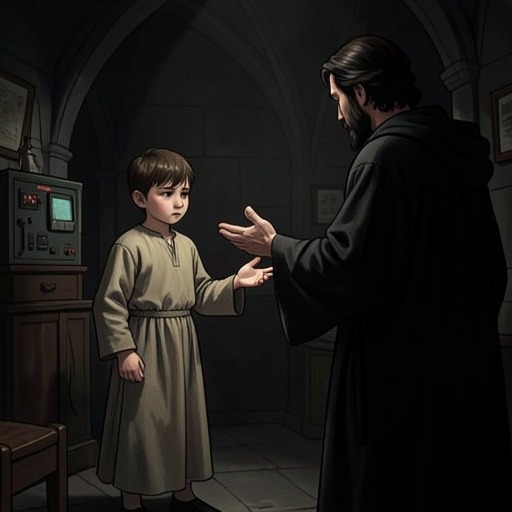
Merlin next arranges Arthur’s fostering. He names Sir Ector as a faithful lord who should take the child, and instructs that Ector’s wife nurse Arthur as her own. When Arthur is born, Uther orders two knights and two ladies to carry him wrapped in cloth of gold and deliver him to the first poor man they meet at the postern. Merlin receives the child and brings him to Ector, where a holy man christens him Arthur and Ector’s wife feeds and raises him. The story thus separates Arthur from his birth family at the outset: Uther is his father, but Ector’s household becomes his home and the truth of his origin remains concealed.
Heirship and Death
Within two years, Uther falls gravely ill while enemies take advantage of his condition and attack his people. Merlin tells him that he must go to the field even if carried in a litter, because his presence is necessary for victory. Uther is borne with a great host to meet a northern army at St Albans. Ulfius and Brastias perform notable deeds, Uther’s forces prevail, and the king returns to London. His victory is followed by a relapse: he becomes speechless for three days and nights.
Merlin tells the assembled barons to come before Uther the next morning. In their hearing, he asks whether Arthur is to succeed his father. Uther turns and publicly gives Arthur his blessing, directs him to pray for his soul, and commands that he claim the crown righteously and honorably, on pain of forfeiting that blessing. Uther then dies. His declaration names Arthur as heir, but does not prevent a succession crisis: after the king’s burial, powerful lords strengthen themselves, and the realm remains in jeopardy as contenders seek the crown.
Merlin and the Archbishop of Canterbury respond by summoning the lords and men of arms to London at Christmas, hoping that a miracle will disclose the rightful king. At the church, a sword is found fixed in an anvil set in a great stone, with a declaration that whoever draws it is the rightful king of England. No claimant can move it at first. This test eventually makes visible the succession Uther announced at his death, while also revealing how little the king’s word alone can settle the realm’s uncertainty.
Arthur’s Recognition and Uther’s Legacy
When Sir Ector asks Sir Kay to try the sword and Kay cannot draw it, Arthur pulls it free with ease. Ector kneels and explains that he is not Arthur’s father, but had been entrusted with his upbringing. Arthur grieves at learning this, then affirms his gratitude to Ector and his wife, who raised him as their own. He promises to reward Ector if he becomes king. Ector asks only that Arthur make Kay seneschal of his lands; Arthur agrees that Kay shall hold the office for as long as they both live. The recognition scene links Uther’s concealed arrangement to Arthur’s first act of acknowledged kingship, while showing that the foster-family bond remains meaningful after the hidden blood relationship is revealed.
The book’s interpretive frame places Uther’s actions at the head of a tragedy that unfolds across generations. It contrasts the concealment of Arthur’s birth, and the later consequences of his unknowing relationship with his sister, with the prosperity and political reach Arthur achieves before the final catastrophe. Arthur’s fellowship brings order to widespread disorder; his power extends across England, Wales, and Scotland, and his campaign to Rome makes him emperor. Yet the account argues that early wrongdoing and prophecy persist beneath this public success. Uther’s part in the story is brief compared with Arthur’s long reign, but its consequences endure: the secret that begins with Uther’s desire becomes the hidden condition of the later royal disaster.